Phoenix Staines
Phoenix Staines
Phoenix Staines, Biomedical Engineering, Class of 2028
Where are you interning, and what is your role?I am a participant in the Summer Research Program at the University of Nebraska–Lincoln, working in the Civil and Environmental Engineering Department under the Sustainability and Resilience program. My research focuses on passive water surveillance, where we collect and analyze pathogens from local streams to better understand environmental monitoring and develop an early warning system for harmful contaminants.
What projects or assignments are you working on?My project focuses on passive water surveillance using absorbent materials such as tampons and gauze to collect bacteria and environmental DNA (eDNA) from local streams. In the lab, we validate how effectively these materials capture pathogens under simulated river conditions to support future early warning systems for water quality monitoring.
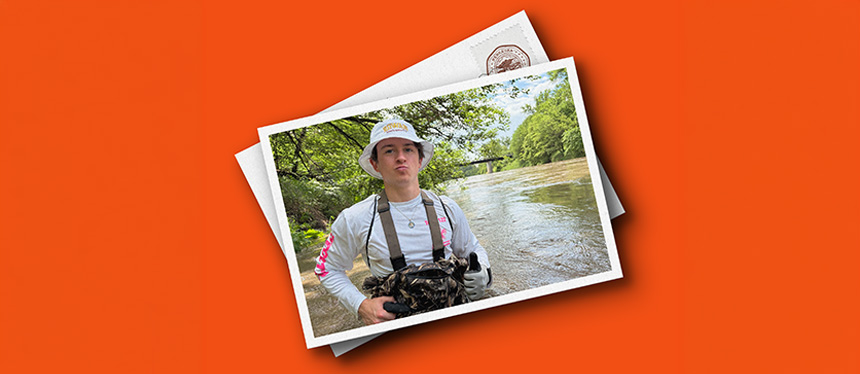
What does a typical day look like?A typical lab day involves micro pipetting, sample processing, and validation experiments. We use a large tumbler with bottles to simulate a flowing river and study how well tampons and gauze absorb bacteria and DNA. Field days begin early in the morning with wading into streams to deploy passive samplers. After remaining in the water for three days to one week, we retrieve the samplers, bag the absorbent materials, and return them to the lab for analysis.
What Rowan class or experience has helped you most?Although it was a challenging course, Foundations in Biology for Biomedical Sciences II helped me the most, along with Chemistry II. Both courses provided a strong foundation for understanding the laboratory techniques and biological concepts used throughout my research.
What new technical or professional skills have you developed?Throughout the internship, I have strengthened my technical writing, data analysis, laboratory, public speaking, and presentation skills. Working on an active research project has also improved my ability to communicate scientific findings effectively.
What has surprised you about working in the biomedical engineering field?As a Biomedical Engineering major, I did not expect to be working in Civil and Environmental Engineering. The biggest surprise was how interconnected the two fields are. Civil and environmental engineers design infrastructure with public health in mind, from roads and bridges to water treatment systems, making their work directly relevant to improving community health.
How has a faculty member or mentor supported you?Dr. Staehle has been incredibly supportive throughout this process. She wrote my recommendation letter and encouraged me to pursue an opportunity outside my major, which ultimately broadened my perspective and provided valuable research experience.
What advice would you give another student pursuing an internship?I would encourage every student to apply. This experience has helped me develop valuable technical and professional skills that future employers will appreciate. I also recommend applying to as many opportunities as possible and starting early, as internships and research programs receive thousands of applications each year.
Complete the sentence: “This summer, I am helping to…”...develop new ways to detect harmful pathogens in the environment before they become a threat to people, animals, and ecosystems.