Casey Barrett
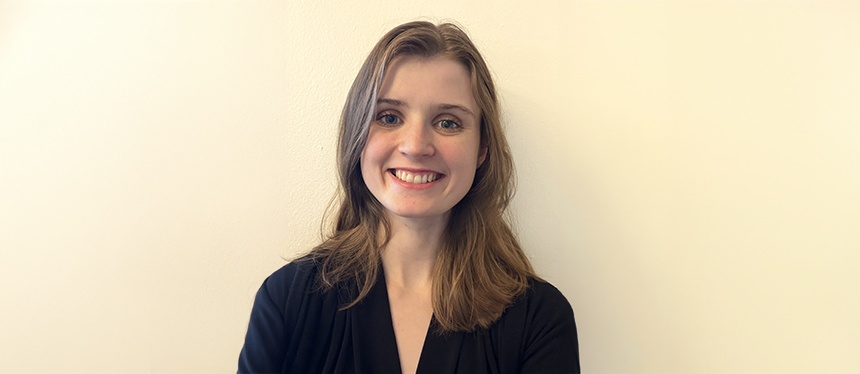
Casey Barrett
Casey Barrett, Ph.D. Candidate in Chemical Engineering
Engineering at the Next Level
What inspired you to pursue a graduate degree in engineering, and why did you choose Rowan University?
It was my experience in clinic as an undergrad at Rowan during my senior year that inspired me to pursue a graduate degree. In this clinic, we were attempting to remove the PFOA contaminants (a kind of PFAS) found in PTFE, also known as Teflon. I loved the complexity of the polymer science involved, but also the sense of purpose that came from knowing our work directly addressed a public health issue while preserving a material society relies heavily on. I stayed on for graduate school because I wanted to continue performing research that addressed a problem like the one in my clinic, and because I enjoyed learning about and studying polymeric materials. I chose to stay at Rowan because I enjoyed the atmosphere and community in the graduate school here.
What degree and engineering discipline are you pursuing, and what is the primary focus of your research or academic work?
I am pursuing a PhD in Chemical Engineering. The primary focus of my research is on thermosetting polymers. To be more specific, we look at what are called dynamic chemistries, which in our case allows the material to partly degrade in response to water.
Was there a particular experience, problem, or person that first sparked your interest in this research area?
I took a Materials class in my sophomore year with Dr. Newell and it started my interest in working with materials as a whole, but it was during my senior year engineering clinic that I became interested in working with polymers.
How has your graduate experience at the Henry M. Rowan College of Engineering differed from what you expected when you began?
It is a lot less linear! I thought everything would be straightforward, like with an undergraduate degree: you just check the boxes, do the classes, the research works perfectly, and bam! PhD. While that may be true for the coursework, I’ve found that the research journey doesn’t always turn out the way you expect it to.
What has been your most meaningful or memorable experience at Rowan so far?
Defending my Master’s last fall!
Research with Impact
Can you describe your research in a way that someone outside your field could understand?
We focus on designing systems that allow us to control the release of boric acid. These can be used to help treat slow-healing wounds or serve as anti-fouling coatings without relying on highly toxic substances.
What challenge or real-world problem is your research trying to address?
One is the issue of “burst release” that occurs in many systems, where the release agents discharge too quickly, preventing a sustained performance. Our method of chemically incorporating boric acid into a polymer can allow it to be released at a more gradual rate. This method should allow us to incorporate boric acid into long-lasting anti-fouling coatings or more short-term wound dressings, depending on how the polymer it’s incorporated into degrades.
Why is this work important, and who could ultimately benefit from it?
Boric acid can assist in accelerating wound healing. This is particularly useful in diabetic wounds, which can heal very slowly. From an anti-fouling perspective, it is effective against common marine fouling agents, such as algae, and can be a more sustainable option than the metals that have previously been used in anti-fouling coatings on ships.
What stage is your research currently in, and what progress or findings are you most excited about?
My PhD research is still in the relatively early stages, but I am currently working on my Proposal Defense, which will make me a true PhD candidate! I’m very nervous but also very excited for it.
What is one research challenge you have encountered, and how did you work through it?
During my master’s we had a machine that seemed necessary to the project not work at all! We were able to look at the work from a different angle, but if we had more time we would have liked to examine our material using that machine.
Have you presented, published, patented, or received funding or recognition for your work? Please share any accomplishments that are especially meaningful to you.
Last year I had the opportunity to present my work at the World Conference on Carbon in Saint Malo, France, which was very exciting! It was so fun connecting with researchers around the world and discussing my work with them. In addition to Carbon, I’ve presented at AMMI’s annual Summer Symposium and the Chemical Engineering Department Seminar.
Does your research involve collaboration with other departments, universities, companies, government agencies, hospitals, or community partners? How have those collaborations strengthened the project?
My Master’s research involved collaboration with the Army Research Lab. The feedback we got from that collaboration was incredibly valuable. It encouraged me to look at my project in a different way: how could this work be used in a real-world application and what, on the lab-scale, is feasible in practice?
Mentorship & Graduate Experience
How has your faculty advisor or research mentor influenced your development as an engineer, researcher, or professional?
My advisor has encouraged me, at every level, to look deeper into my work. Through our discussions, I have learned that by focusing on the fundamentals of polymer science, it is much easier to understand the work on a larger scale. He also pushes me to develop myself as a professional, by encouraging me to present my work often and attend conferences.
Are there other faculty members, lab colleagues, or collaborators who have played an important role in your graduate experience?
The list is so long! For one, my Master’s advisor, Dr. Newell, was the reason I even considered graduate school in the first place, and Dr. Stanzione and Dr. Haas, who were on my Master’s committee, came to biweekly meetings and offered me advice and support like they would their own students. When I first started grad school, I worked closely with Will Beck, another grad student, who helped me so much as I was learning the ropes. Throughout my Master’s, my other labmate, Dr. Matt Schwenger, was such a great source of mentorship for me. And of course since starting my PhD, my current lab mates, Jaclyn, Ethan, and Koushik, who are always willing to discuss any questions I have or help out with unfamiliar experiments, have been invaluable. Also the other ChemE graduate students, whose camaraderie is essential to getting through grad school.
What technical, research, leadership, or communication skill have you developed most during your graduate program?
It is hard to pinpoint one specific skill, but probably my public speaking skills. Public speaking was always one of my weaknesses and it is difficult to avoid in graduate school. I practice presenting my work every week at group meetings, I present yearly at the Chemical Engineering Department Seminar and AMMI’s annual Summer Symposium, and of course there are presentations at the conferences I attend. These experiences all involve some amount of public speaking and allowed me to push myself out of my comfort zone repeatedly, making me a much more confident and effective public speaker.
Have you had opportunities to mentor undergraduate students, teach courses, assist in laboratories, or support other students? What have you learned from those experiences?
I have had the opportunity to mentor clinic students for two years, and even had my own intern for a summer! One of the biggest takeaways for me has been learning how to adapt my approach to where the student is at. As a grad student even a few months in, it can be easy to forget how overwhelming the material can feel to someone seeing it for the first time. I’ve learned to meet students at their level and break concepts down into manageable steps.
How have Rowan’s facilities, laboratories, resources, or industry connections supported your work?
Being a part of AMMI (the Advanced Materials and Manufacturing Institute) means that I have connections throughout the university. Having direct access to researchers and faculty outside my committee has given me a much broader pool of connections to draw from whenever I need equipment not available in my lab (such as the Raman in the Physics department or borrowing an induction cooktop from Mechanical Engineering) or if I just need a fresh perspective.
Beyond the Lab
Are you involved in any professional organizations, student groups, conferences, competitions, internships, or community activities? How have these experiences shaped you?
I am currently the President of Rowan’s Engineering Graduate Student Association, where I have served on the board for two years. I am also the Chair of the Chemical Engineering Graduate Student Committee. Overall, these experiences have taught me skills such as networking, budgeting in an organization, and organizing events as well as the value of community. Being in these positions has also really allowed me to grow into my leadership style.
How do you balance research, coursework, teaching, professional development, and life outside of graduate school?
It’s tough! But it is important to understand that graduate school is more a marathon than a sprint. That means prioritizing what is most important on any given day. For example, if I had an exam coming up, it was acceptable if I spent a few hours less in the lab that week. I also really try to make sure I have some time outside of graduate school for myself every day, even if it's just an hour to go on a walk outside or 30 minutes to play with my cat.
What has graduate school taught you about persistence, problem-solving, or working through uncertainty?
Navigating those three things is an almost inevitable part of grad school. For a research degree, especially a PhD, you’re trying to learn something entirely new. That inherently comes with some amount of uncertainty. For me personally, finding a balance between persistence and problem-solving is key. Doing benchwork, I had to understand where my progress was limited by the capabilities of the lab. Sometimes a piece of equipment that feels necessary to the work does not work for months or at all, and it was here where creativity comes into play, either by changing the project to look at things from a different angle, or learning how to get answers without it. Graduate school taught me that persistence doesn’t mean going back and doing the same test on the same broken machine every day and expecting different results, but instead understanding that the same answers can often be found in a different way.
What advice would you give to a student considering a master’s or doctoral degree in engineering?
I think reflecting on your future career first is a good idea. A graduate degree isn't necessary for every engineering job out there, but if you enjoy the research process and want a career that constantly challenges you in that same way, it’s worth it.
Beyond that, when considering where to go for graduate school, it's important to enjoy the work you’ll be doing, but it is also very important to get a feel for the culture of the lab you’d be joining. Advising style, work culture, and what your labmates are like all will vary between groups, so it’s important to find one that will fit your style.
Looking Ahead
What are your professional goals after completing your graduate degree?
My professional goal after completing my degree is to join an industry or national lab team where I can continue working directly with polymers. I want to use my background to develop non-toxic, sustainable materials that make a positive impact on people’s health and daily lives.
How do you hope to apply your research and graduate experience in your future career?
I want to take what I’ve learned about polymer science and apply it in a field that allows me to work toward solving a problem for the benefit of others, whether that’s by providing a more sustainable option to a nonrenewable polymer or toxic chemical or by developing a more effective material for medical use.
Where do you hope your field of engineering will be in the next five to ten years?
I hope that we will see a scale-up of a lot of the work that is now done on the lab scale. I see a lot of work being done with “dynamic” polymers, which show a lot of promise as degradable, self-healing, and reprocessable materials, and I hope to see more of that work brought out off the bench and on to a more industrial scale.
What kind of impact do you hope to make as an engineer, researcher, educator, or industry professional?
It sounds a little cliché, but I really hope to design materials that leave the world a bit better off, whether that means creating a safer, less toxic alternative or engineering materials that can be more easily kept out of landfills.
Your Engineer’s Lens
What is something in everyday life or in your field that you now view differently because of your graduate research?
Plastics. I didn’t realize how much of our current world is built by polymers.
If resources and time were unlimited, what engineering problem would you most want to solve, and why?
A scalable, perfectly recyclable thermosetting polymer would be amazing. So much of our waste comes from plastics that can’t be recycled, but plastics are also so necessary to our current world.
What is one misconception people often have about your research or engineering discipline?
Not everything that is “bio-based” is renewable or biodegradable. That only tells you where the material came from, not necessarily how it will behave!
Quick Hits
Graduate degree and expected graduation year: PhD in Chemical Engineering, 2029
Research advisor: Dr. Palmese
Research area in five words or fewer: Thermosetting polymers with dynamic bonds
Favorite piece of laboratory equipment, software, or research tool: Excel
Most-used item during a long day in the lab: Round-Bottom Flask
Favorite place to work or recharge on campus: Saxby’s (Sorry Einstein’s!)
Best conference, class, or professional experience so far: The World Conference on Carbon 2025
One word that describes your approach to research: Determined
Complete the sentence: “My research matters because…” it provides a controllable release of a wound healing treatment and a more sustainable anti-fouling agent.
Complete the sentence: “I chose graduate engineering because…” I love to learn!