Improving the Lives of Veterans
Improving the Lives of Veterans
Improving the Lives of Veterans
Engineers often contribute to projects with real-world impacts, but it may take years until the fruits of their labor reach the public. One group of Rowan engineering students had the rare opportunity to make a material impact on the life of a veteran through a one-year clinic project.
"Participating in this project was an incredibly rewarding experience. It provided a unique opportunity to apply engineering principles in a practical setting while collaborating closely with my team and outside experts... This experience not only highlighted the importance of teamwork and interdisciplinary collaboration but also reinforced how engineering creates meaningful real-world impact." — Joshua Perry, biomedical engineering alumnus and MBA student at Rowan University
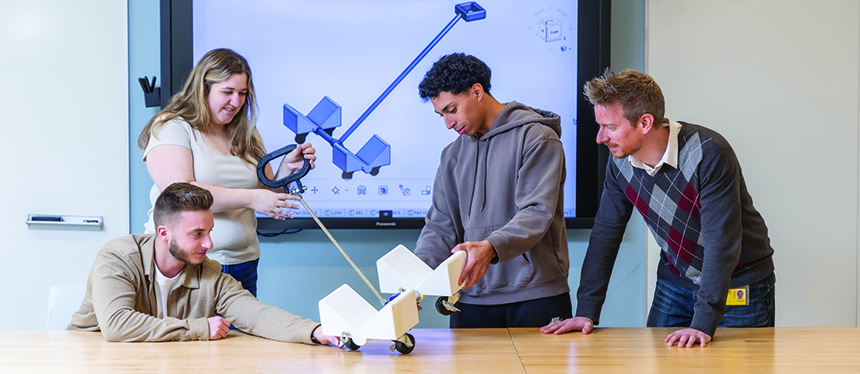
Students Joshua Perry, Anna Sasse, Bailey Erikson, Christopher Iuliucci, Marvin Aguilera Moreno and Alexa Warren worked under the direction of Erik Brewer, Ph.D., an associate teaching professor in the Department of Biomedical Engineering, to create an attachment for strollers and shopping carts to help a blind veteran better maneuver these items while using his white cane.
The project is part of an ongoing collaboration with Quality of Life Plus, a national nonprofit that partners with universities across the country to engage engineering students in creating personalized solutions for injured veterans and first responders.
The team met with U.S. Army veteran Mike Nelson, who, due to injuries sustained during military service, is visually impaired. He shared his difficulties taking his children for walks in a stroller while using his visual assist cane and asked the team if they could design a pulling mechanism attachment, allowing him to guide a stroller or shopping cart behind him while using his cane in front of him.
Before the first mockups were sketched, the students needed to gather information. The first few months of the project were dedicated to interviews with disability advocates, occupational and physical therapists and content creators in the disability community to gather information that would help inform their design. Through these conversations, they learned what products were already commercially available, whether the attachment would allow Nelson to push the cart or pull it and how to make the attachment as easy to maneuver as possible.
This fact-finding mission helped prepare students for future careers, especially as entrepreneurs, where interviewing and problem-solving are crucial to understanding a client’s needs. One student from the team, Joshua Perry, is following this entrepreneurial path and has founded his own company and is currently pursuing his MBA at Rowan.
Once the team determined the attachment would be a pull mechanism, then came the design phase. How would the attachment look? How to make it adaptable to different-sized strollers and shopping carts? How to make the handle the most comfortable for Nelson? Once a design was solidified, students turned to their core engineering skills to prototype and test the attachment.
After they designed and manufactured the attachment, the students presented the final product to Nelson at the end of the academic year, a rewarding experience to see the tangible impact of their work.
The team also presented their work at the Northeast Bioengineering Conference at Stevens Institute of Technology.