Preventing Falls with Engineering
Preventing Falls with Engineering
Preventing Falls with Engineering
Falls pose serious health threats for people of all ages and abilities. A postal service worker in wintertime might skid as they navigate icy sidewalks. An elderly person might lose their balance while grocery shopping. A dish washer in a kitchen runs the risk of slipping on soapy dishwater.
"Working with Dr. Trkov on this project has profoundly influenced not only my academic and professional career but also my life... connecting me with some of the most talented and inspiring people I know. One of the most rewarding aspects has been getting to work as part of a team, to collaborate with incredible individuals and to see all of us grow together." — Zachary Roberts, mechanical engineering major
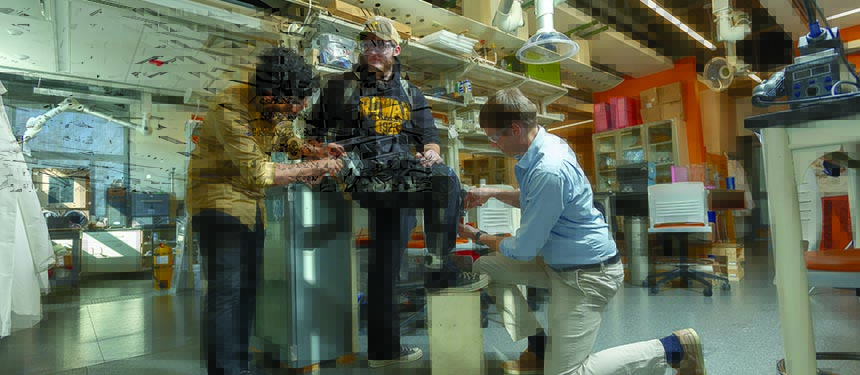
Rowan engineers are designing a device that would prevent these falls. For a clinic project, Mitja Trkov, Ph.D., an assistant professor in the Department of Mechanical Engineering, led student researchers in the design and testing of a wearable exoskeleton device meant to assist with lower-limb placement and thus prevent falls.
The multi-disciplinary team included undergraduate students Zachary Roberts, Sarah Smith, Luca Franco, Preston Haddon, Nathan Mains and Fawaz Mallick. Mechanical, electrical and biomedical engineering majors were represented in the project. Biomechanical engineers focused on the user perspective, while mechanical engineers experimented with joint range of motion and other device requirements. Electrical engineers developed the electrical aspects of the exoskeleton.
The clinic project was part of ongoing multi-year research, sponsored by the National Science Foundation. In 2021, students working on this project won a clinic award for best research in mechanical engineering.
Many existing exoskeletons are designed for rehabilitation or long-term assistance, offering support for repetitive walking movements. Trkov’s exoskeleton can be worn by anyone who might be at risk of slipping. The device then offers corrective external assistance, physically manipulating the body to stop the wearer from falling. To do so, compressed air cylinders that have been installed along the back will release the compressed air into air cylinders that pull the cable-driven mechanism on the back leg when a slip occurs. The device will encourage the wearer to ground their back foot.
During clinic, students improved the prototype of the device by making it more ergonomic and comfortable for the wearer and to have better control. Student researchers also integrated air cylinders and electronics in a backpack and improved hip and knee actuation mechanisms. They then tested the device in the lab without human subjects.
Due to the interdisciplinary nature of the project, students practiced collaboration in a real-world research environment. Because the exoskeleton will ultimately be used by humans, they had the additional challenge of developing a safe, comfortable device. Trkov hopes to test the device on human subjects
in 2025.
Students eventually went on to co-author conference publications and secure internships and job offers based on their contributions.