Sk Md Imdadul Islam
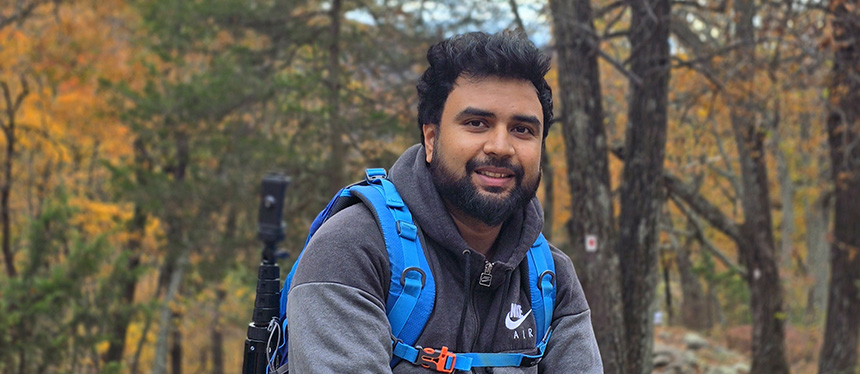
Sk Md Imdadul Islam
Sk Md Imdadul Islam, Ph.D. Candidate in Civil & Environmental Engineering
Meet Sk Md Imdadul Islam, a Ph.D. candidate in Civil Engineering at Rowan University whose research could help solve two of America's most pressing challenges: waste plastic pollution and deteriorating transportation infrastructure.
"An important reason why my research has significance is that it generates a circular economy and strengthens our national security by transforming an environmental liability into a profitable resource for crucial infrastructure."
Imdad studies how to incorporate waste plastics into asphalt pavements, creating more durable, sustainable roads and military airfields while reducing plastic waste in landfills. His work, funded by the U.S. Department of War, could lead to longer-lasting pavements in cold regions and support U.S. military readiness. His research excellence has been recognized with the Best Poster Award at Rowan University's Graduate Research Day (2026) and the People's Choice Award (2025) for his impactful presentations. With over 100 citations and 23,000+ reads of his research, his work on sustainable materials has gained global recognition. He has eight published/in review/under preparation research articles from his PhD work in renowned journals/conferences including Transportation Research Record, Materials, Sustainability and Results in Materials, and his findings have been cited by researchers across multiple countries.
Beyond the lab, Imdad serves as Vice President of Rowan's Engineering Graduate Student Association, mentors’ undergraduate students, and is an active member of the American Society of Civil Engineers (ASCE), Texas Society of Professional Engineers (TSPE) and he holds an Engineer-in-Training (EIT) certification. Previously, he gained hands-on industry experience managing multiple construction materials testing projects as well related to transportation infrastructure.
Engineering at the Next Level
What inspired you to pursue a graduate degree in engineering, and why did you choose Rowan University?
My inspiration to pursue a graduate degree in engineering began during my undergrad research and even grew bigger at the time of my Master's research at the University of Texas at RGV, where I worked on subgrade soil stabilization with solid waste, waste plastics utilization in concrete and developing conductive concrete for electrochemical water disinfection. I was drawn to the challenge of modifying traditional construction material to serve a completely new purpose, like enhancing materials strength and purifying drinking water, while addressing a critical public health issue. I chose Rowan University for my Ph.D. because of its strong reputation in sustainable infrastructure research, especially with CREATES which is the only academic institution in the northeast region of the US that has the facilities to conduct state-of-the-art accelerated pavement testing, and the opportunity to work on the Department of War funded project “incorporating waste plastics into asphalt pavements.” The collaborative environment and the chance to contribute to research with direct national security and environmental implications made Rowan the ideal place to continue my journey.
What degree and engineering discipline are you pursuing, and what is the primary focus of your research or academic work?
I am pursuing a Ph.D. in Civil Engineering, with a specialization in Transportation Engineering. The primary focus of my research is on developing sustainable, high-performance pavement materials by incorporating waste plastics into asphalt binders and mixtures. My work addresses two interconnected challenges: the growing crisis of plastic pollution and the need for more durable, resilient infrastructure. I investigate how different types of recycled plastics and stabilizers affect the storage stability, rheological properties, and long-term performance of asphalt, particularly in cold regions where pavement cracking is a major concern.
Was there a particular experience, problem, or person that first sparked your interest in this research area?
My interest in sustainable infrastructure materials was sparked during my junior year undergraduate studies, where I took a course on solid waste management and witnessed the dual challenges of rapid urbanization and inadequate waste management firsthand. Later, during my master’s program, I worked on converting waste materials into valuable construction resources, including a project on plastic coating for recycled concrete aggregates. When I met Dr. Mehta and learned about Rowan University's project on plastic-modified asphalt, I knew it was the perfect opportunity to combine my passion for environmental sustainability with my engineering skills to create solutions that benefit both civilian infrastructure and national security.How has your graduate experience at the Henry M. Rowan College of Engineering differed from what you expected when you began?
Classes, research, papers, and graduation. I thought there was a natural progression to my PhD. The courses are scheduled but the research has been more inconsistent than predicted. Surprising findings are the reason experiments can lead to useful discoveries. I worked on plastic modified asphalt, and I learned that stabilizers are more crucial to prevent phase separation than plastic compatibility. This modified my research and produced unanticipated outcomes. I have learnt to appreciate the iterative nature of study, where failures are opportunities to build on hypotheses and understanding.
What has been your most meaningful or memorable experience at Rowan so far?
My favorite memory at Rowan was winning the Best Poster Award at Graduate Research Day in 2026. It was really an honor to receive such recognition among more than 100 participants from all majors within the entire university. It is good to have academics and peers from across disciplines recognize my research on waste plastics in asphalt pavements. But more than the award, the occasion allowed me to connect with other researchers and faculty in the university.
Research with Impact
Can you describe your research in a way that someone outside your field could understand?
My research focuses on transforming waste plastics, things like single-use water bottles and packaging, into stronger, longer-lasting roads and military airfields. Think of it like this: plastic waste is a huge environmental problem, and our roads are constantly cracking and deteriorating. My work aims to solve both problems at once by taking recycled plastics and incorporating them into asphalt, the material used to pave roads.
What challenge or real-world problem is your research trying to address?
I am tackling two interconnected challenges. First, the United States generates over 40 million tons of plastic waste annually, but only about 5-6% is recycled. Most end up in landfills or the environment. Second, our nation's transportation infrastructure is aging and deteriorating faster than ever due to climate change and rapid growth with changing load pattern in traffic. Traditional asphalt pavements crack in cold weather, rut in hot weather, and require frequent, costly repairs. My research addresses both by developing new formulations where recycled plastics are chemically and physically integrated into asphalt, improving its durability while providing a large-scale use for waste plastic which can create a circular economy as well.
Why is this work important, and who could ultimately benefit from it?
This work is important because it addresses three national priorities simultaneously. First, national security, my research is funded by the Department of Defense and aims to create more durable airfields and roads in cold regions, directly supporting military readiness and troop safety. Second, environmental sustainability, by creating a high-volume market for recycled plastics, we can significantly reduce plastic pollution and advance the circular economy. Third, economic efficiency, longer-lasting pavements mean fewer repairs.
What stage is your research currently in, and what progress or findings are you most excited about?
My Ph.D. research is currently in a progressing and exiting stage where I have successfully developed and characterized several storage-stable plastic-modified asphalt binder formulations that show significant improvement in low-temperature performance, critical for cold-region military applications. I have completed laboratory testing including rheological analysis, fracture energy evaluation, and long-term aging simulations. Most excitingly, my findings have been recognized through multiple presentations at the Transportation Research Board (TRB) Annual Meeting in 2026 and accepted for publication in the prestigious Transportation Research Record. I am now moving toward the next phase: field validation using Accelerated Pavement Testing (APT) to confirm laboratory results translate to real-world performance.
What is one research challenge you have encountered, and how did you work through it?
One significant challenge I encountered was the phase separation issue when mixing composite plastics with asphalt binders. Initially, the plastics would separate from the binder during storage, creating an uneven distribution that would compromise pavement performance. Rather than skipping the blending approach, I systematically evaluated different stabilizers and mixing protocols. Through extensive experimentation, I identified that certain reactive elastomeric terpolymers can effectively bridge the compatibility gap between plastic and asphalt with the presence of a crosslinking agent. This discovery not only solved the phase separation problem but also improved the overall performance of the modified binder.
Have you presented, published, patented, or received funding or recognition for your work?
I am honored to share several meaningful accomplishments. My research has been recognized with the Best Poster Award at Rowan University's Graduate Research Day in 2026 and the People's Choice Award in 2025. I have presented my work at the prestigious Transportation Research Board (TRB) Annual Meeting and the New Jersey Department of Transportation (NJDOT) Research Showcase. I have published in reputed journals including Sustainability, Materials, Results in Materials, accepted for publication in TRR and my work has been cited over 100 times by researchers across more than 25 countries. My Ph.D. research is funded by the U.S. Department of Defense, and I have received competitive fellowships including the Terracon Graduate Fellowship, the NSPE Edmundo Gonzalez Scholarship, and the Engineering Endowment Fellowship.
Does your research involve collaboration with other departments, universities, companies, or government agencies? How have those collaborations strengthened the project?
My research involves multiple collaborations that have significantly strengthened the project. My primary funding comes from the U.S. Army Engineer Research and Development Center (ERDC) and the Cold Regions Research and Engineering Laboratory (CRREL), ensuring my work directly addresses real military needs. I have collaborated with the New Jersey Department of Transportation (NJDOT) by presenting at their Research Showcase and receiving direct feedback from state engineers on the practical applicability of my work. I am also engaged with Chemical Engineering department at Rowan University having Dr. Xu in my dissertation committee member as many of my experiments involved polymer modification and chemical interactions between them. I have also worked with Princeton University and Physics department of Rowan University while conducting Atomic Force Microscopy for my samples. In addition to my research, I worked on a project with Dr. Gordon which was funded by Phenegra Corporation, a recipient of the Harvard Business School’s Tough Technology Award, through a grant from the New Jersey Commission of Science, Innovation and Technology (NJCSIT). All these collaboration helped me widen my interdisciplinary knowledge and think from a different point of view while solving issues related to my research.
Mentorship & Graduate Experience
How has your faculty advisor or research mentor influenced your development as an engineer, researcher, or professional?
Dr. Yusuf Mehta has been instrumental in my development as a researcher and professional. He has consistently encouraged me to think beyond the laboratory and consider the broader implications of my work, how it can be translated into real-world applications that benefit both civilian infrastructure and national security. He always says, “first look for the word “why” and then go for “how” while looking into a problem. Through our regular discussions, I have learned the importance of grounding my research in fundamental materials science while keeping a clear focus on practical implementation. He has also pushed me to develop my professional presence by encouraging me to present at major conferences like the TRB Annual Meeting and the ASCE T&DI Conference, and to engage directly with state DOT. His mentorship has taught me that impactful research requires not only technical rigor but also effective communication and collaboration with diverse audiences.
Are there other faculty members, lab colleagues, or collaborators who have played an important role in your graduate experience?
I have been fortunate to have a strong support network throughout my graduate journey. Assistant research professor Dr. Anil Kumar Baditha, project manager in my research work, and Associate Director of CREATES, Dr. Ayman, always guided me and helped me out while I am lost in the deep blue sea. My Master's advisor at UTRGV, Professor Dr. Kim and supervisor Dr. Pham, Dr. Vu, first sparked my interest in sustainable materials research and gave me the foundation I needed to pursue my Ph.D. Within the lab at Rowan, I have benefited immensely from collaborating with fellow researchers and discussing challenges. Beyond my immediate lab, my work has been enriched by collaborations with independent experts like Professor Jamilla Teixeira at the University of Nebraska-Lincoln. I am also grateful for the engagement with professionals like Andres Palma at Millennium Engineers Group and Dr. Daniel Offenbecker at the Federal Aviation Administration, Dr. Ben C. Cox, and Dr. Mohammad Elshaer at ERDC who have helped me bridge the gap between academic research and federal infrastructure priorities.
What technical, research, leadership, or communication skills have you developed most during your graduate program?
One of the most significant skills I have developed is the ability to communicate complex research to general audiences. Early in my graduate career, I struggled to explain my work on plastic-modified asphalt to people outside civil engineering. But through repeated practice, presenting at TRB, speaking at NJDOT Research Showcase, mentoring undergraduate researchers, I have become a more confident and effective communicator.
Have you had opportunities to mentor undergraduate students, teach courses, assist in laboratories, or support other students? What have you learned from those experiences?
Yes, I have had multiple opportunities to mentor and teach throughout my graduate career. As a Graduate Teaching Assistant at UTRGV, I instructed undergraduate laboratories in Transportation Engineering, Foundation Design, and Earthwork courses, where I learned to break down complex concepts into accessible steps for students encountering them for the first time. I also served as a mentor in the Summer Bootcamp for the College of Engineering and Computer Science at UTRGV, helping incoming students develop foundational skills. As part of Summer CREATES Cadet Program (2025), I provided laboratory training and guidance to a U.S. Coast Guard Academy cadet on incorporation of waste plastics into asphalt pavement. One of the most important lessons I have learned through mentoring is that patience and adaptability are essential, every student learns differently, and effective mentorship requires meeting them where they are and building their confidence step by step.
How have Rowan's facilities, laboratories, resources, or industry connections supported your work?
Rowan's facilities and resources have been critical to the success of my research. The CREATEs lab and Department of Civil and Environmental Engineering is equipped with advanced equipment. The access to these advanced instruments has allowed me to conduct rigorous analysis of plastic-modified binders and validate my formulations. Equally important are Rowan's strong industry and government connections.
Beyond the Lab
Are you involved in any professional organizations, student groups, conferences, competitions, internships, or community activities? How have these experiences shaped you?
I am actively involved in several professional organizations and student groups. I currently serve as Vice President of Rowan's Engineering Graduate Student Association. I am also an active member of the American Society of Civil Engineers (ASCE) and the Texas Society of Professional Engineers (TSPE), where I served on the Engineers Week 2023 planning committee, an experience that taught me the value of community outreach and promoting STEM education.
These experiences have shaped me in several ways. First, they have developed my leadership and organizational skills, from planning events to managing budgets and coordinating with diverse stakeholders. Second, they have expanded my professional network, connecting me with practicing engineers, policymakers, and researchers who have provided valuable mentorship and career guidance. Third, they have reinforced my commitment to giving back to the engineering community and helping develop the next generation of professionals.
How do you balance research, coursework, teaching, professional development, and life outside of graduate school?
One of the main challenges of graduate school is juggling these competing expectations. I use the daily importance and urgency. Before starting of a week, even every day, I make my schedule prioritizing my important task and follow my own time frame to check the box at the end of the day. I may be more research oriented if I have a lot of lab experiments to run or conference deadlines to meet, but during exam weeks I focus on schoolwork. Leadership has taught me to say no to non-essential commitments and to delegate when it is appropriate. I take breaks from work every day, even if it is only a short walk, or seeing family and friends. This keeps me grounded and keeps burnout away.
What has graduate school taught you about persistence, problem-solving, or working through uncertainty?
Graduate school has taught me that persistence and problem-solving are not only about brute force, but they are also about adaptability and creativity. Early in my Ph.D., I encountered significant challenges with phase separation when incorporating composite plastics into asphalt binders. The initial formulations would separate during storage, creating uneven distributions that would compromise pavement performance. Rather than abandoning the approach or repeating the same failed experiments, I had to step back and approach the problem from a different angle.
I systematically evaluated different stabilizers, mixing protocols, and processing conditions, eventually identifying that certain reactive elastomeric terpolymers could effectively bridge the compatibility gap between plastic and asphalt. This required not only technical expertise but also the patience to work through dozens of iterations and the eager to seek advice from colleagues and mentors outside my immediate field.
Through this experience, I learned that uncertainty is not something to be feared but embraced as an inherent part of pushing the boundaries of knowledge. Graduate school has taught me to trust the process, even when the path forward is not clear.
What advice would you give to a student considering a master's or doctoral degree in engineering?
My advice would be twofold: first, reflect carefully on your career goals and whether a graduate degree aligns with them. A master's or Ph.D. is not necessary for every engineering job, but if you are genuinely passionate about research, innovation, and solving complex problems, it can be an incredibly rewarding path. I chose to pursue a Ph.D. because I wanted to work on challenges that have real-world impact, like plastic pollution and infrastructure resilience, and because I enjoy the process of discovery and contribution to knowledge.
Second, when choosing a program, look beyond the curriculum and consider the research environment and lab culture. The advisor you work with, the dynamic of the lab group, and the resources available will shape your experience far more than the reputation of the university alone. Before committing, I would encourage prospective students to speak with current graduate students, visit labs, and get a sense of whether the culture aligns with their working style and values.
Finally, I would remind them that graduate school requires patience, resilience, and a willingness to embrace uncertainty.
Looking Ahead
What are your professional goals after completing your graduate degree?
After completing my doctorate, my goal is to continue advancing sustainable infrastructure materials in a role that bridges research and real-world implementation, whether at a national laboratory, a federal agency, or in industry R&D. I want to apply my expertise in polymer-modified materials to develop scalable, cost-effective solutions that address the dual challenges of plastic pollution and infrastructure deterioration.
How do you hope to apply your research and graduate experience in your future career?
I hope to take the foundational knowledge I have gained in materials characterization, polymer science, and pavement engineering and apply it to accelerate the adoption of sustainable infrastructure technologies. Specifically, I want to bridge the gap between laboratory innovation and field implementation, working with state DOTs, federal agencies, and industry partners to develop standardized specifications, testing protocols, and performance models for recycled plastic-modified materials. My industry experience at Millennium Engineers Group taught me the importance of practical feasibility, regulatory compliance, and cost-effectiveness.
Where do you hope your field of engineering will be in the next five to ten years?
In the next five to ten years, we will see widespread adoption of recycled plastic-modified materials in mainstream infrastructure construction. Currently, many promising laboratory innovations struggle to transition to full-scale implementation due to inconsistent standards, limited performance data, and industry hesitancy. I envision a future where state DOTs and federal agencies routinely specify recycled content in pavement materials, supported by standard performance specifications and lifecycle data. I hope to see the circular economy principles as well.
What kind of impact do you hope to make as an engineer, researcher, educator, or industry professional?
I hope to leave a lasting impact by helping transform the way the United States builds its infrastructure. My work aims to show that environmental responsibility and engineering excellence can go hand in hand, that we can build stronger, longer-lasting roads while simultaneously addressing the plastic waste crisis. Beyond my research, I want to contribute to training the next generation of young engineers by mentoring students and sharing my experiences.
Your Engineer’s Lens
What is something in everyday life or in your field that you now view differently because of your graduate research?
Plastic waste. Before my graduate research, I saw plastic as primarily an environmental problem, something to be minimized and avoided. Now, I view it as a valuable resource with potential. Through my work on plastic-modified asphalt, I have come to appreciate that discarded plastics can be repurposed into high-performance construction materials, offering a second life for materials that would otherwise end up in landfills or the environment. I now see plastic bottles, bags, and packaging not just as waste, but as potential ingredients for stronger, more durable roads.
If resources and time were unlimited, what engineering problem would you most want to solve, and why?
If resources and time were unlimited, I would most want to develop a fully scalable, cost-effective system that can selectively sort, process, and incorporate any type of plastic waste into high-performance infrastructure materials. I would love to develop a comprehensive framework that allows us to predict the performance of any given plastic mixture in asphalt or concrete, based on its chemical composition and physical properties. This would eliminate the need for extensive trial-and-error experimentation and enable rapid, optimized formulations tailored to specific infrastructure applications.
What is one misconception people often have about your research or engineering discipline?
One common misconception is that using recycled materials in construction automatically means compromising on quality or performance. Many people assume that "recycled" or "sustainable" materials are inherently weaker or less durable than conventional options. My research demonstrates that this is not the case, when properly formulated and tested, plastic-modified asphalt can actually outperform traditional materials in key performance metrics, including rutting resistance, fatigue cracking, and low-temperature performance. Another misconception is that the primary driver for using recycled plastics is environmental concern alone. In reality, there are also significant economic and strategic benefits, reducing material costs, strengthening domestic supply chains, and decreasing dependence on fossil-fuel-based virgin materials.
Quick Hits
Graduate degree and expected graduation year: PhD in Civil Engineering, 2026
Research advisor: Dr. Yusuf Mehta, P.E.
Research area in five words or fewer: Sustainable plastic-modified asphalt pavements
Favorite pieces of laboratory equipment, software, or research tool: Dynamic Shear Rheometer (DSR) and Fluorescence Microscopy (FM)
Most-used item during a long day in the lab: High shear blender and asphalt binder samples
Favorite place to work or recharge on campus: The Engineering Building's graduate lounge (perfect for a quick coffee break)
Best conference, class, or professional experience so far: Presenting at the Transportation Research Board (TRB) Annual Meeting in Washington, D.C., the energy and exchange of ideas with researchers from around the world was unforgettable.
One word that describes your approach to research: Persistent
Complete the sentence: "My research matters because…" it turns waste plastics into durable, sustainable infrastructure, strengthening both our economy and national security.
Complete the sentence: "I chose graduate engineering because…" I wanted to solve real-world problems that make a noticeable difference in people's lives and the environment.